Showing posts with label scottish culture. Show all posts

Sunday, March 20, 2011

Scotland for the Win!

Yesterday I went with some friends to watch the Scotland vs. Italy game of the Six Nations rugby tournament. The six nations included are Scotland, England, Wales, Ireland, Italy, and France.  We were supporting Scotland, obviously, and it was not only a very exciting game but we also won, which was even better!
I don't really understand the rules of rugby aside from how to score and the basics of play.  Basically, just enough to know when to scream and cheer for my team.  We got really into the spirit of it, and dressed up despite the cold-it was well worth the effort.  Actually, there were a lot of great outfits in support of both sides.
 We took a bus to Murrayfield Stadium, where the game was.  On the way back we walked, because the fans took over the streets and stopped all the traffic!  I don't know if you can tell from the picture, but all the Edinburgh city buses have tartan upholstery on the seats.  Obviously, I am a huge fan of this.
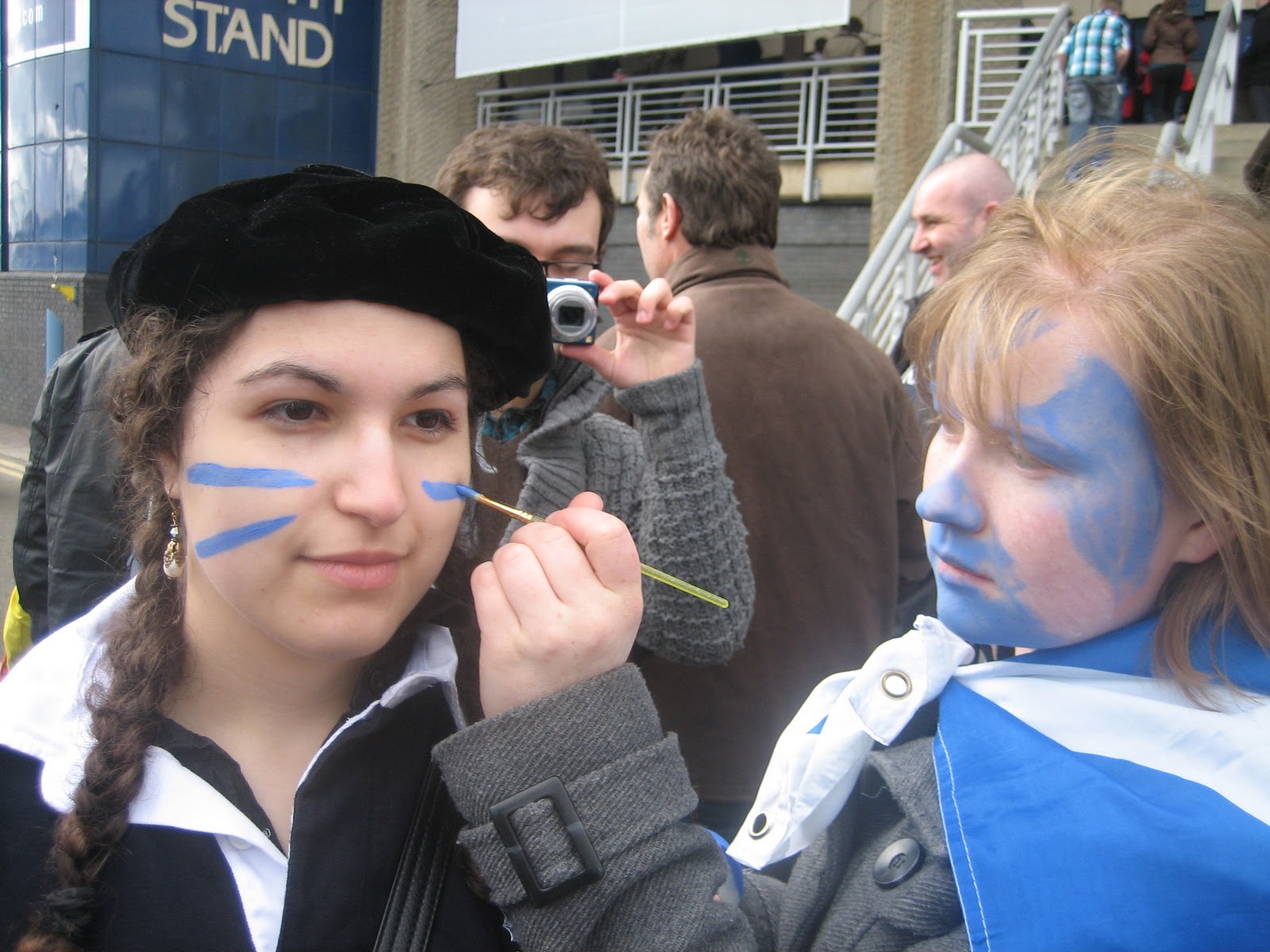
 We're outside the stadium itself here, proudly sporting the Scottish flag, which is called the Saltire.  It is also known as the St. Andrew's Cross--St. Andrew is the patron saint of Scotland, and Saint Andrews Day is a national Scottish holiday.  We celebrated it this fall with--what else?--haggis, neeps, and tatties.
 Naturally, there had to be war paint.  I broke in the face paint by giving Ailie a full-face Saltire, and then the rest of us got stripes on each cheek.  Ailie also wrote 'FREEDOM' on Martin's forehead, a la Braveheart.


We were so much fiercer.

 It turned out we had amazing seats, behind one the the goal posts and pretty far forward-you could see the whole game easily, which was good since I was still trying to master the rules.  It was a lot more exciting than I usually find watching sports to be-quite possibly because it was really violent and awesome.  And we won. That always helps.


 The playing of the national anthems was also a lot more exciting than I'm used to.  The flag bearers marched around the bagpipers and drummers to form a Saltire with their flags across the field...and then when the Scotland team was announced, there were flames and fireworks.  I think if American teams entered through giant flames and fireworks came off the roof of the stadium, I might be more interested.

 The game was very exciting-we didn't score until the second half, and it was quite tense up until the final countdown...followed by massive cheers and lots of jumping around.  We walked back into town with the rest of the crowd and stopped at the Southsider, a pub near my flat, to celebrate with Irn Bru, which is a Scottish soda.  I think it's awful: it's bright orange and tastes/smells like bubble gum, but I haven't yet met a Scot that didn't like it.  Supposedly it's also a great hangover cure, but I've never had a need to try that, thankfully.  The commercials for Irn Bru are fantastic, though-I recommend looking some up.  Also, it outsells Coca-cola here, which is pretty incredible.
Scotland won 21-8. Cheers!

Tuesday, March 15, 2011

Post-Essay Fun

My last essay of the semester is due on Thursday, and I'm almost done with it.  I've at least done as much as I can right now...so I'm taking a break and feeling very inspired.  As previously mentioned, I've gotten really into tartan as a historical fashion thing this year.  I've already planned out a tartan ballgown, but it's expanding into tartan for every period of the 19th century.  I've learned some really interesting things, though!
Here's a dress from the BBC series of Wives and Daughters, which is extra cute because there's some discussion in the show about how it's not a 'proper' tartan.
and here's a real one from a slightly earlier period (and by real I mean image of a fashion plate, sent to me by the wonderful author of this blog):

the hat makes this one

Thanks to Wives and Daughters, I've fallen in love with the ridiculousness of the 1820s:

Parisian Ladies, 1826
1820-1835


And you can never go wrong with a tartan sash...

1863

Queen Victoria, c. 1850s
This one is totally unrelated, and of a Colonel stationed in India, but how cool is he?!


I'm still digging up examples, so depending on how busy I am, I might post some more.  In the process of doing all this research, I learned that the US also has a long history with tartan-did you know that April 6 is National Tartan Day in America?
It's even an official holiday as of 2008.

Many states also have their own tartans, including Massachusetts, which has the 'bay state tartan'!
It's amazing what weird things you find out on the search for fashion references.

Thursday, March 3, 2011

The Lady in the Gallery

In addition to our lovely morning hike and cupcake picnic, my friends and I also went to the National Gallery of Scotland yesterday.  The museum has a lovely collection of art, both from Scotland and throughout the world.  I had a lot of fun looking at the portraits, on loan from the National Portrait Gallery while it undergoes a massive renovation.  There was one of a Highland military man who had designed is own uniform, complete with red argyle socks, green tartan trowsers, a sporran, and a tartan drape over his military jacket!! I haven't been able to find a picture of it online, so you'll just have to take my word for how spectacular it was.
another portrait I loved, by Grant, 1857
As I've mentioned before, I love late nineteenth century art--especially Impressionism.  I was thrilled to discover the 19th century gallery, located off the main floor.  When I reached the top of the stairs, I turned to look into the gallery and came face to face with an old friend!
Lady Agnew of Lochnaw, John Singer Sargeant 1892
This is Lady Gertrude Vernon Agnew.  Her portrait was done by American artist John Singer Sargeant in 1892.  The reason this was so exciting for me is that I wore her dress to my first ball at the Astors' Beechwood Mansion in Newport, RI.
...well, sort of.  The first year I attended Newport Vintage Dance Week, the wonderful Katie Bishop loaned me some dresses she had made so that I would have something to wear to the various events.  The dress I wore to the 1890s ball at the Beechwood was after the dress in this painting.  I thought this was really neat, and spent a lot of the night attempting to take a picture of myself in the same pose as the original.  It didn't go particularly well, but here is the best attempt:
Had my posture been better, it would have worked, I think.

 I definitely jumped up and down and squealed a bit in the gallery, and everyone looked at me like I was crazy.  oh, well.

We saw a lot of other really lovely paintings, including a Seurat and several Degas.  Degas is one of my favorite artists, so this was really exciting.  Also one of his bronze casts, but a less famous one so it was new to me! yay!
Arabesque, c.1882-1895
La Luzerne, Saint-Denis by Georges Seurat
We saw a lot of other beautiful work too, from many different periods.  In particular, the National Gallery has (shockingly) a great collection of Scottish art.  Raeburn is the most famous, I think, for Americans, but there were lots of others I had never heard of.
the Raeburn I think is most famous, Reverend Walker Ice Skating on Duddingston Loch
One I really liked was Joseph Paton.  I'd seen The Reconciliation of Oberon and Titania before, but not its pair.
The Quarrel of Oberon and Titania
There were also some names I did recognize, like James Drummond.  I had never seen his work before, but I live just across from Drummond Street!


Saturday, February 19, 2011

Just Some Thoughts (another sick day...)

So, I'm sick again (grumble grumble).  I'm pretty sure I've managed to catch every nasty cold most British kids get the whole time they're in primary school.  Eventually my immune system has to catch up...sigh.  But in the meantime, I've actually been really productive in getting homework done, and after a week I am finally feeling a lot better.
Last night I went to my friend's 21st birthday party, which was Sex and the City themed and a lot of fun.  Here we are with her big balloons:
The thing that makes her party blog-worthy (aside from how great it was), though, is the fact that just for her birthday, just because she wanted to, she had a ceilidh (traditional Scottish dance).  Since so many of her friends are part of New Scotland and/or Scottish, we were able to just go for it.  A few of the dances were taught, but for the most part such a large percentage of the group knew the steps that they were able to just drag the few people who didn't through them.  It was pretty awesome, and something I wish I could do at home.  Unfortunately, I haven't quite trained my friends that well...yet.

Other than that, there isn't much to report.  Lots of homework (only 4 weeks left of semester 2 classes! aahh!) and getting over the plague...again.  I made chicken soup from scratch today, almost the way my mom makes it-I can't get the stuff to make matzo balls here.  It did get me thinking about how magical chicken soup is, though, which reminded me of a great book I read as a kid: Stone Soup.
It's an old folk tale, and there are lots of versions of it, but the basic story is that there is a village somewhere that is having a famine.  People have food in their homes, but no one really has enough to eat.  Then a man comes to town with a cast iron pot, and offers to make stone soup to share with the village.  He fills the pot with water and drops in a plain old stone.  As it boils he says "you know what would make this soup even better? cabbage! oh, well..." and lo and behold, one of the villagers offers a cabbage they were hiding under the bed.  This continues until all of the village families have offered something, and together everyone's meager offerings have created a wonderful, delicious soup!
Maybe my first graders can try reading it.  Soup is great stuff, and teamwork is even better.  My flatmate and I have been studying hard all week, and we're sharing my soup for dinner tonight :)

Thursday, February 3, 2011

First Grade Friends 5

Hello Bailey First Graders!

I hear you have been having a lot of snow days!  The weather in Edinburgh is nice and warm (in the 40s) but a bit rainy sometimes.  A couple of weeks ago my friends and I celebrated the Scottish holiday called "Burns Night," which is a day celebrating Robert Burns.

Robert Burns was a poet born on January 25, 1759 in Scotland.  He is called Scotland's National Poet, which is why we celebrate his birthday.  Burns wrote many poems about Scotland, and he wrote in English and Scots, which is a Scottish language (another is Gaelic).  For Burns Night, we had a "Burns Supper," which is a party where everyone eats traditional Scottish food: haggis, neeps, and tatties.  Neeps and tatties are Swede and Potatoes, and haggis is meat with seasonings and oats.  It's really yummy!

At the start of the dinner, a poem is read called Address to the Haggis, which was written by Burns.  It's all about the delicious food we are about to eat!  It is written in Scots, but you can also get an English translation.  Here is the last bit of the poem (called a stanza):

Ye Pow'rs wha mak mankind your care,
And dish them out their bill o' fare,
Auld Scotland wants nae skinking ware
That jaups in luggies;
But, if ye wish her gratefu' prayer,
Gie her a haggis!


and in English:


You powers who make mankind your care
And dish them out their meals
Old Scotland wants no watery food
That splashes in dishes
But if you wish her grateful prayer
Give her a haggis! 


Do you have any poems that your family likes to read?  What about special dinners you celebrate?  (What about Thanksgiving?)  


Burns wrote many poems and songs during his life.  Have you ever written a poem?  Give it a try!


America celebrates poetry too.  April is National Poetry Month.  If you were planning a poetry party, what would you eat?  What would you do at the party?  Maybe you could try writing a poem to read out loud for your guests.


Monday, January 31, 2011

Melrose Abbey

So in my post about Refreshers' Weekend I mentioned that on Sunday we visited the ruins of a twelfth century abbey.  It was flurrying a bit while we were there an pretty cold, which seemed perfectly gloomy and atmospheric for wandering around the ruins.  The site was founded in 1136 by Cistercian monks, and the abbey was built in different sections between its founding and the sixteenth century.  The Cistercian monks who lived there were a silent order, and were very involved in local production and sheep farming.  The town of Melrose grew up around the abbey during the years, and was a target of many attacks during wartime from the 13-1500s.  It ceased to function as a monastery in 1590, and was afterwards used as a community church.
 Due to the many attacks on the place, very little of the original structure still stands.  Most of the site is full of foundations from earlier parts of the buildings that were destroyed.
 Melrose Abbey also holds a graveyard and various memorial plaques on the walls throughout the structure.  I was really excited because a lot of the writing is in Latin-I had an easier time deciphering that than I did the bits in Scots!  One of the most famous supporters of the Abbey was Robert the Bruce, who was king from 1306-1329.  He's a legendary hero in Scottish history, and led the Scots during the War of Scottish Independance.  Before his death, Robert requested that his heart be removed from his body when he was dead and taken on crusade (which he had failed to do during his lifetime) and then buried in Melrose Abbey (his body is buried elsewhere).
 His wished were carried out, and the embalmed heart of Robert the Bruce is now interred at the abbey.  It was excavated during restoration work in the 1990s, and reburied with this commemorative stone.  It says A noble hart may have nane ease  Gif freedom failye.
 The construction of the abbey is really beautiful, and a lot of the intricate work around the windows and inside alcoves is still in pretty good shape.
At the corners of each window arch were faces, and each one was making a different expression:

 Throughout the ruins of the other wings of the complex were little signs about life as a monk and what each part of the building would have been used for.  I listened to an audio guide provided by Historic Scotland, which preserves the abbey, which was really interesting.  This section of foundation was for the abbey kitchen--my favorite room!
 One of the sixteenth century buildings has been converted into a museum about the place, so we explored in there as well.  This sign was on the fence as we went inside:
 I thought it was funny, because it's not often one needs to be warned about medieval culverts.  It was an actual warning though-the culverts weren't roped off or anything.
one of the culverts
In the museum I learned that before the abbey was built, the area had been the site of a Roman military fort from when Britain was part of the Roman Empire.  During excavations many artifacts from the Roman era of the place have been discovered, and we got to see a few of them, like these stones.
 The fort was under the control of Governor Agricola, which I was really excited to find out.  When I took Latin we used the Cambridge Latin Course, which uses a soap-opera-esque series of stories to teach vocabulary and grammar.  In the later textbooks, the main character goes to Britain and Agricola is featured in the story, as is his successful conquering of Scotland.  Naturally, this had to be explained to everyone I was with because otherwise the jumping up and down I was doing looked a little nuts.
a plan of the Roman fort

the workings of a sixteenth century abbey clock
The museum was interesting, and the ruins as a whole were really beautiful.  It was a nice break for my calves from all the dancing, too!  We never did find the gargoyle that's supposed to be shaped like a pig, though...
I'll leave you with an excerpt from The Lay of the Last Minstrel, written by Walter Scott:
f thou would'st view fair Melrose aright, 
Go visit it by the pale moonlight; 
For the gay beams of lightsome day 
Gild, but to flout, the ruins grey. 
Where the broken arches are black in night, 
And each shafted oriel glimmers white; 
When the cold light's uncertain shower 
Streams on the ruin'd central tower; 
When buttress and buttress, alternately, 
Seem fram'd of ebon and ivory; 
When silver edges the imagery, 
And the scrolls that teach thee to live and die;
When distant Tweed is heard to rave 
And the owlet to hoot o'er the dead man's grave 
Then go—but go alone the while—
Then view St. David's ruin'd pile;
And, home returning, soothly swear, 
Was never scene so sad and fair! 

Sunday, January 23, 2011

My First Ball at Which There is More Than One Accordion in the Band

Last night I went to the New Scotland Annual Dance, which was my first big formal event.  It was really daunting at first, because none of the dances were really taught on the floor the way I'm used to-instead, they would be called through once slowly enough that it could be walked quickly by the top couple, and then recapped.  The figures also weren't called during the dancing.
I made it through just fine, though!  I messed up, but everybody in the set worked together to make it through.  Here's a video of Yan Tan Tethera, one of the dances on the program:


While it was definitely a little stressful to learn dances on the fly that way, it was also really cool to get through them without a caller.  It was especially fun knowing that it would have been similarly done at 19th century balls, even though we do it rarely at vintage dance events.

Thursday, January 13, 2011

A Weekend in the Country

(can you name that musical?)

I'm off to Sheffield, England for the weekend.  I'm staying at my flatmate's house and we're going to see one of the big estates near her.  She lives right in the middle of a bunch of them, and also near where Pride and Prejudice takes place! Wish I had my Regency clothes with me!

This weekend was orientation for the new international students, and I was recruited to work as a tour guide...some things never change!  My friend Sean was also guiding with me, and I got him to take a few pictures of me in my red hoodie/uniform.  We're standing in front of Bedlam, the only completely student-run theatre in the UK (by U of Edinburgh students, obviously).  It's called Bedlam because it's right near the sight of the old Asylum.


I'm pretty sure I was the only one excited about the asylum stuff...oh, well.  Sean and I had fun, and they fed us lunch.  I'm working at the nursery tomorrow, but I'll finish my Hogmanay posts and share pictures from this weekend when I get back.  Happy Friday!

Thursday, December 16, 2010

A Quest to De-stress

This morning I finished my exams! Cue my massive sigh of relief and pleasure.  Tomorrow I need to do practical things like clean my room, organize this semester's academic ruffage, go to the library, and go to work.  Today, though, I am taking some time to de-stress and work on a project I've been thinking about for a while but haven't been able to investigate.
That subject is my next (some day very far off) sewing project.  Last summer I started playing with the idea of making a new 1860s ball gown.  The dress I have now is very special to me, and was made by the lovely Katy Bishop from shot silk.  Shot silk is woven from two colors, so it looks different from different angles/in different light-mine is blue and green.
on the carousel at the Rotunda Ballroom in Newport, RI in 2008 
Being in Scotland has really inspired me to do something with tartan.  One of the things I learned in my Scottish history class this semester was that the whole tartan/clan connection became a much larger phenomenon thanks to royal interest during the early nineteenth century, and became an fashion craze during the mid-century after Queen Victoria and Prince Albert purchased Balmoral Castle in the 1840s.  Queen Victoria seems to have been a great fan of tartan herself-check out all the tartan in the Balmoral drawing room:
you can see more pictures at Victoria's World
So knowing that much, I had a feeling I could find evidence of tartan in ladies' evening wear from the 1860s.  It turned out to be a little harder that I was expecting, but after some serious digging today I have choices!!  As I mentioned, Victoria liked tartan, and I found this great portrait of her in a cream dress and tartan sash from the 1850s.
 So that's option number one.  I don't know what tartan she's wearing (so I don't know what tartan it is), but based on some of the research I've been doing and the light areas I'd guess it's the Stewart Dress tartan, which looks like this:
or rather, this is what it looks like in wool, which is not what I'd make a dress out of.  Because tartan is woven, if I want real tartan I have to use woven fabric, which means any tartan on my dress will have to be silk.
Anyways, I kept looking.  I found an auction site with listings for pieces from the wardrobe of Queen Alexandra, which were being auctioned for charity in 1937.  One of the dresses was tartan! And better yet, not hideous!
This is the original auction description:
"27
SCOTTISH TARTAN AND WHITE SATIN CRINOLINE BALL DRESSPlaid satin panniers in the Royal Stuart tartan over a separate skirt of white satin ruffles outlined in red, with internal stiffening. Pointed bodice with pleated bertha trimmed with black lace, and short white tulle sleeves. With belt and separate collar. Worn at the Scottish Balls at Balmoral when H. M. the Queen first came to England"


However, this dress is later than the period I'm aiming for (mid-nineteenth century).  So I started looking for other pictures from balls at Balmoral castle.  In 1863, the Princess of Wales wore this dress to the annual ball:
It looks very similar to the previous one.  My guess is that one was a copy of this dress (done without the hoops), and that both are Stewart tartans, since the auction listing says that tartan is the Royal Stewart, and the white on this one makes me think it's the Dress Stewart.  
I don't love the underskirt on this one-it's too fussy for me, and I think the red trim would be a little too much with a bright tartan.  However, I'm very pleased with the overall style of the dress.  I think I would prefer to make something similar to this, rather than a plain dress with a sash in tartan, but we'll see.  I've found a great source for silk tartan, and scans of 19th century tartan sample books so I can cross-reference patterns for historical accuracy.  I'd like to do a cream/gold underskirt to bring out the yellow in the tartan; if I use a different tartan I'll use one with yellow highlights.  


Off to celebrate the end of exams at dance tonight!  I'll keep my eye out for any tartans I like.