Saturday, February 19, 2011

Just Some Thoughts (another sick day...)

So, I'm sick again (grumble grumble).  I'm pretty sure I've managed to catch every nasty cold most British kids get the whole time they're in primary school.  Eventually my immune system has to catch up...sigh.  But in the meantime, I've actually been really productive in getting homework done, and after a week I am finally feeling a lot better.
Last night I went to my friend's 21st birthday party, which was Sex and the City themed and a lot of fun.  Here we are with her big balloons:
The thing that makes her party blog-worthy (aside from how great it was), though, is the fact that just for her birthday, just because she wanted to, she had a ceilidh (traditional Scottish dance).  Since so many of her friends are part of New Scotland and/or Scottish, we were able to just go for it.  A few of the dances were taught, but for the most part such a large percentage of the group knew the steps that they were able to just drag the few people who didn't through them.  It was pretty awesome, and something I wish I could do at home.  Unfortunately, I haven't quite trained my friends that well...yet.

Other than that, there isn't much to report.  Lots of homework (only 4 weeks left of semester 2 classes! aahh!) and getting over the plague...again.  I made chicken soup from scratch today, almost the way my mom makes it-I can't get the stuff to make matzo balls here.  It did get me thinking about how magical chicken soup is, though, which reminded me of a great book I read as a kid: Stone Soup.
It's an old folk tale, and there are lots of versions of it, but the basic story is that there is a village somewhere that is having a famine.  People have food in their homes, but no one really has enough to eat.  Then a man comes to town with a cast iron pot, and offers to make stone soup to share with the village.  He fills the pot with water and drops in a plain old stone.  As it boils he says "you know what would make this soup even better? cabbage! oh, well..." and lo and behold, one of the villagers offers a cabbage they were hiding under the bed.  This continues until all of the village families have offered something, and together everyone's meager offerings have created a wonderful, delicious soup!
Maybe my first graders can try reading it.  Soup is great stuff, and teamwork is even better.  My flatmate and I have been studying hard all week, and we're sharing my soup for dinner tonight :)

Thursday, February 3, 2011

First Grade Friends 5

Hello Bailey First Graders!

I hear you have been having a lot of snow days!  The weather in Edinburgh is nice and warm (in the 40s) but a bit rainy sometimes.  A couple of weeks ago my friends and I celebrated the Scottish holiday called "Burns Night," which is a day celebrating Robert Burns.

Robert Burns was a poet born on January 25, 1759 in Scotland.  He is called Scotland's National Poet, which is why we celebrate his birthday.  Burns wrote many poems about Scotland, and he wrote in English and Scots, which is a Scottish language (another is Gaelic).  For Burns Night, we had a "Burns Supper," which is a party where everyone eats traditional Scottish food: haggis, neeps, and tatties.  Neeps and tatties are Swede and Potatoes, and haggis is meat with seasonings and oats.  It's really yummy!

At the start of the dinner, a poem is read called Address to the Haggis, which was written by Burns.  It's all about the delicious food we are about to eat!  It is written in Scots, but you can also get an English translation.  Here is the last bit of the poem (called a stanza):

Ye Pow'rs wha mak mankind your care,
And dish them out their bill o' fare,
Auld Scotland wants nae skinking ware
That jaups in luggies;
But, if ye wish her gratefu' prayer,
Gie her a haggis!


and in English:


You powers who make mankind your care
And dish them out their meals
Old Scotland wants no watery food
That splashes in dishes
But if you wish her grateful prayer
Give her a haggis! 


Do you have any poems that your family likes to read?  What about special dinners you celebrate?  (What about Thanksgiving?)  


Burns wrote many poems and songs during his life.  Have you ever written a poem?  Give it a try!


America celebrates poetry too.  April is National Poetry Month.  If you were planning a poetry party, what would you eat?  What would you do at the party?  Maybe you could try writing a poem to read out loud for your guests.


City Literature

I just finished re-reading Pride and Prejudice, and am moving on the Fleshmarket Close by Ian Rankin.  Rankin's series about an Edinburgh detective are good little pulp mysteries, but are especially interesting because many of the scenes take place in areas I frequent.  The one I just finished, The Falls, took place almost completely in my neighborhood.
I've already talked about Elephant House in an earlier post, which is the cafe J.K. Rowling says she started writing Harry Potter in (and along with several other cafes nearby, was where she wrote the first book).  In honor of the inspiration Edinburgh had for the series, Rowling also finished it here, booking a suit at the Balmoral Hotel to complete the seventh book.  According to interviews, so wrote a message in an alcove in the room and signed it the night she finished the series.  If you ever book a suit at the Balmoral, don't forget to look!

I wanted to take a minute and plug the Inspector Rebus series as another great Edinburgh connection to modern fiction.  There's even an iPhone app that provides a Rebus-themed walking tour of the city!  I've already read Strip Jack and The Falls, and am starting Fleshmarket Close today.  If you're interested, read along with me!

Monday, January 31, 2011

Melrose Abbey

So in my post about Refreshers' Weekend I mentioned that on Sunday we visited the ruins of a twelfth century abbey.  It was flurrying a bit while we were there an pretty cold, which seemed perfectly gloomy and atmospheric for wandering around the ruins.  The site was founded in 1136 by Cistercian monks, and the abbey was built in different sections between its founding and the sixteenth century.  The Cistercian monks who lived there were a silent order, and were very involved in local production and sheep farming.  The town of Melrose grew up around the abbey during the years, and was a target of many attacks during wartime from the 13-1500s.  It ceased to function as a monastery in 1590, and was afterwards used as a community church.
 Due to the many attacks on the place, very little of the original structure still stands.  Most of the site is full of foundations from earlier parts of the buildings that were destroyed.
 Melrose Abbey also holds a graveyard and various memorial plaques on the walls throughout the structure.  I was really excited because a lot of the writing is in Latin-I had an easier time deciphering that than I did the bits in Scots!  One of the most famous supporters of the Abbey was Robert the Bruce, who was king from 1306-1329.  He's a legendary hero in Scottish history, and led the Scots during the War of Scottish Independance.  Before his death, Robert requested that his heart be removed from his body when he was dead and taken on crusade (which he had failed to do during his lifetime) and then buried in Melrose Abbey (his body is buried elsewhere).
 His wished were carried out, and the embalmed heart of Robert the Bruce is now interred at the abbey.  It was excavated during restoration work in the 1990s, and reburied with this commemorative stone.  It says A noble hart may have nane ease  Gif freedom failye.
 The construction of the abbey is really beautiful, and a lot of the intricate work around the windows and inside alcoves is still in pretty good shape.
At the corners of each window arch were faces, and each one was making a different expression:

 Throughout the ruins of the other wings of the complex were little signs about life as a monk and what each part of the building would have been used for.  I listened to an audio guide provided by Historic Scotland, which preserves the abbey, which was really interesting.  This section of foundation was for the abbey kitchen--my favorite room!
 One of the sixteenth century buildings has been converted into a museum about the place, so we explored in there as well.  This sign was on the fence as we went inside:
 I thought it was funny, because it's not often one needs to be warned about medieval culverts.  It was an actual warning though-the culverts weren't roped off or anything.
one of the culverts
In the museum I learned that before the abbey was built, the area had been the site of a Roman military fort from when Britain was part of the Roman Empire.  During excavations many artifacts from the Roman era of the place have been discovered, and we got to see a few of them, like these stones.
 The fort was under the control of Governor Agricola, which I was really excited to find out.  When I took Latin we used the Cambridge Latin Course, which uses a soap-opera-esque series of stories to teach vocabulary and grammar.  In the later textbooks, the main character goes to Britain and Agricola is featured in the story, as is his successful conquering of Scotland.  Naturally, this had to be explained to everyone I was with because otherwise the jumping up and down I was doing looked a little nuts.
a plan of the Roman fort

the workings of a sixteenth century abbey clock
The museum was interesting, and the ruins as a whole were really beautiful.  It was a nice break for my calves from all the dancing, too!  We never did find the gargoyle that's supposed to be shaped like a pig, though...
I'll leave you with an excerpt from The Lay of the Last Minstrel, written by Walter Scott:
f thou would'st view fair Melrose aright, 
Go visit it by the pale moonlight; 
For the gay beams of lightsome day 
Gild, but to flout, the ruins grey. 
Where the broken arches are black in night, 
And each shafted oriel glimmers white; 
When the cold light's uncertain shower 
Streams on the ruin'd central tower; 
When buttress and buttress, alternately, 
Seem fram'd of ebon and ivory; 
When silver edges the imagery, 
And the scrolls that teach thee to live and die;
When distant Tweed is heard to rave 
And the owlet to hoot o'er the dead man's grave 
Then go—but go alone the while—
Then view St. David's ruin'd pile;
And, home returning, soothly swear, 
Was never scene so sad and fair! 

Sunday, January 30, 2011

The Sequel

In October I went along on New Scotland's "Fresher's Weekend" retreat and had a blast.  It was so much fun that some of my friends/the committee members decided it would be a good idea to do it again in second semester.  This time we went to Melrose, another historic Scottish town, and again I got very little sleep...but it was such a blast!  We spent Friday night and all day/night Saturday dancing, then went back to the hostel for a jam session with whatever flutes/accordions/guitars were around and singing.  I was really amazed to realize how far I've come as a dancer since October-at the first weekend I could barely get through "Mairi's Wedding" (one of my favorite dances now) and this time I could do the whole thing without it being called and didn't mess up once!  I don't have a ton to say about the weekend, except that it was a great couple of days away with a bunch of other crazy dance kids.  Pictures!

sculpting the fondant
 The theme for the weekend was Harry Potter, and it was also one of the girls' birthday.  I was asked to make a surprise birthday cake for her in the theme for Friday night.  I decided to do a Hogwarts crest, and I was really pleased with the way it turned out!
the Hufflepuff badger
 The cake was red velvet with cream cheese frosting, covered in fondant.  All of the house mascots were also sculpted out of fondant, which was a lot of fun to do!
the Gryffindor lion

the finished cake

Sanne really liked it, and it was a lot of fun to present during the dance.  I was really proud of myself--and I got to eat red velvet cake, which I love and you can't really get in Scotland.

During the day on Saturday were classes, some normal Scottish dance classes and workshops by society members who also do other dance forms.  I took Cuban Salsa and Lindy Hop, and taught a vintage dance class! I was really excited and nervous, but a ton of people came and they seemed to have a great time.  I taught 1860s waltz and used the time to talk about some of the issues that I see on the dance floor a lot, both at home and at ceilidhs here: leading well and steering.  I hope the lesson sticks!  Being crashed into walls is no fun.
On Saturday night there was a "fancy dress" (aka costume) dance, which shamefully I didn't put much effort into.  I went as a Slytherin, and wore a basic schoolgirl-looking thing.  I have a bunch of HP costumes, but they're all in the States. sigh. oh, well.  Some people got really into it, and the costumes were pretty cool even if they weren't very elaborate:
two of my friends as the golden snitch and Fleur Delacour

another friend as Professor Umbridge (he stayed in character all night too, which was hilarious)
 Today (Sunday) we went to Melrose Abbey, the ruins of a twelfth century abbey which was also the site of a Roman fort under governor Agricola.
 It was really cold (it was also snowing a bit), but the abbey and grounds were beautiful.  It was fun to walk around with my friends and explore the site and the museum that's also on the grounds.
 I want to write a post solely on the abbey, so I'll have more to say about it and more pictures of the structure later.  Afterwards, we went to the only place open in town (Melrose is very small-there was one line of shops and that was the whole town center)--a tea shop down the street from the abbey.  We spent the rest of the afternoon having tea and cake and chatting, as usual :)  I'm exhausted, but it was well worth it.  Yay dancing!

Sunday, January 23, 2011

My First Ball at Which There is More Than One Accordion in the Band

Last night I went to the New Scotland Annual Dance, which was my first big formal event.  It was really daunting at first, because none of the dances were really taught on the floor the way I'm used to-instead, they would be called through once slowly enough that it could be walked quickly by the top couple, and then recapped.  The figures also weren't called during the dancing.
I made it through just fine, though!  I messed up, but everybody in the set worked together to make it through.  Here's a video of Yan Tan Tethera, one of the dances on the program:


While it was definitely a little stressful to learn dances on the fly that way, it was also really cool to get through them without a caller.  It was especially fun knowing that it would have been similarly done at 19th century balls, even though we do it rarely at vintage dance events.

Tuesday, January 18, 2011

"Every park has its beauty and its prospects; and Elizabeth saw much to be pleased with" ~Pride and Prejudice

This weekend I went home with my flatmate, and her family took me around Sheffield and the nearby countryside in Derbyshire so I could see some of England.  It rained the entire time I was there (which itself seemed very English), but I had a lot of fun!  It was a nice trip before heading into the really serious business of academics I will be immersed in for the next nine weeks while I have classes.
I loved the area, because it was exactly what I imagine when I read Jane Austen novels-which makes sense, as several key parts of Pride and Prejudice take place in Derbyshire.  The patchwork of fields and stone walls also reminds me of what I think home would have looked like in the eighteenth and early nineteenth centuries to a certain extent-that plus all of the historical places really felt like stepping back in time.

 The first place we visited was the village of Eyam, which is known as the "Plague Village."  In 1665 the bubonic plague arrived in Eyam via a roll of cloth that had been shipped from London.  The fabric was damp, so it was hung before the fire to dry--which revived the plague-infected fleas inside and released them into the air.
In order to prevent the spread of the disease, the town quarantined itself.  Boundaries were decided on each side of the village, and no one from inside was allowed to go beyond those boundaries, and no one from outside was allowed to enter them.

The plague tore through Eyam for fourteen months and claimed the lives of at least 260 villagers.  Some of the original cottages still survive today, and are still private residences. Many of the other seventeenth century buildings also still exist, including the church.  The Eyam church now has a small exhibit about the plague and other parts of the village's history.  The church itself was originally a Norman church, and some of the original pieces can still be seen from the inside.  There is also an eighth century cross in the churchyard, which is a famous Eyam image.

I thought the village was really interesting, especially because there are a lot of village traditions that still carry on today.  One was the annual sheep roast, the "revolving roasting jack" for which was proudly displayed on a green towards the center of town.  I was visiting off season, so most of the museums were closed, but the buildings themselves were really neat because of the stone work, and the stained glass windows in the church were lovely.


Next we went to the Chatsworth Estate, which is home to the Duke and Duchess of Devonshire and two villages.  We stopped in the farm store to poke around and pick up a few treats, most of which were grown/made locally.  There was a huge assortment of meats-everything from wild board to pheasant and pigeon!  There was also an entire counter for savory pies, which is probably my favorite English food...yum!
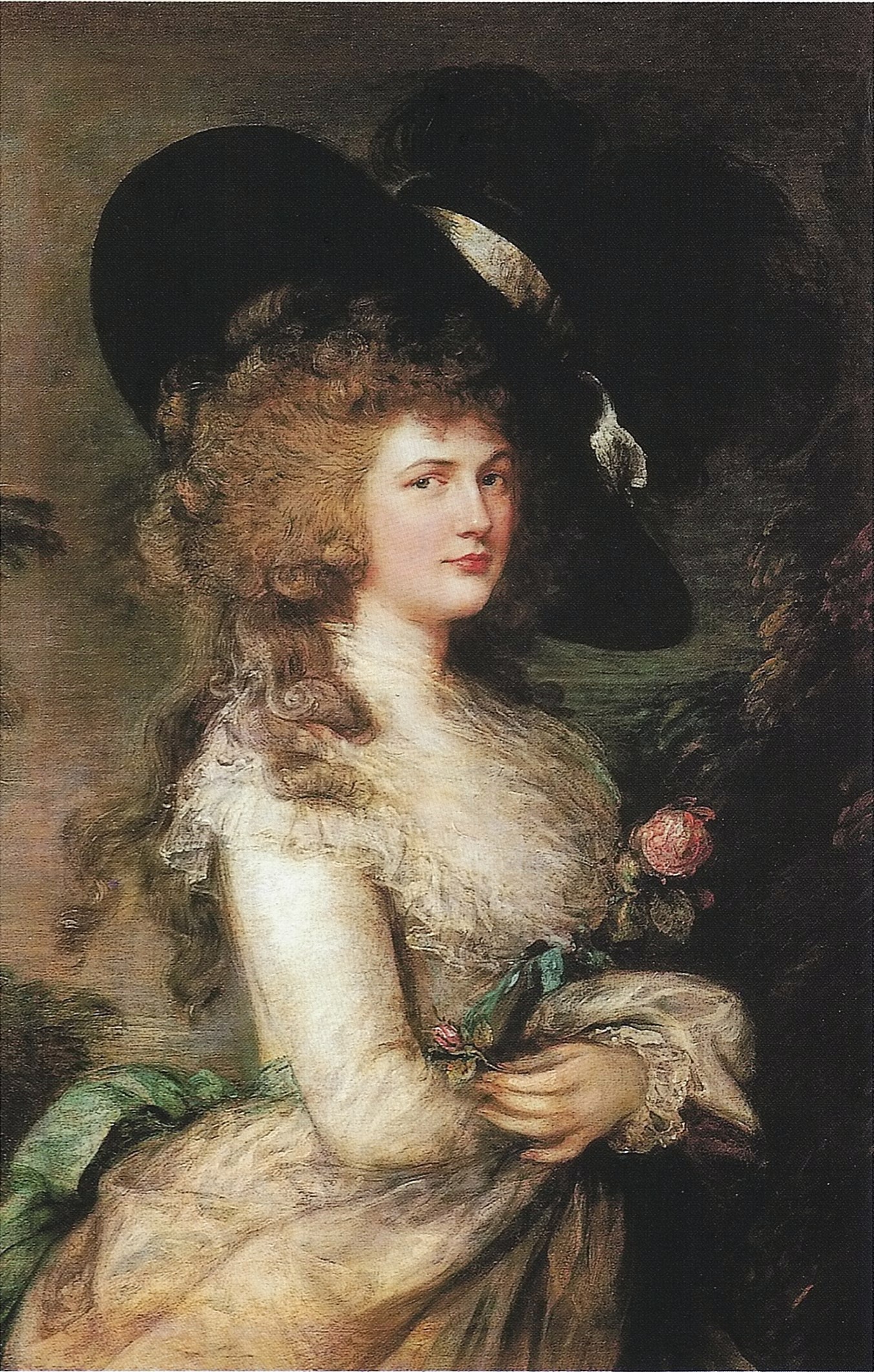
The current Chatsworth House was built at the turn of the eighteenth century, after the original structure burned down.  It has recently appeared in The Duchess, a movie about one of the house's most famous residents: Georgiana Cavendish, first wife of the 5th Duke of Devonshire.  (for those not as interested in the history: Princess Diana was one of her descendants.)
The Duchess herself, 1787
Georgiana Cavendish lived a fairly scandalous life: her best friend was also her husband's mistress, and all three lived together.  Georgiana had her own affair as well, and was friends with another controversial figure-Marie Antoinette.  More importantly, Georgiana actively campaigned for the Whig party at a time when women were rarely involved openly in politics and published a novel in 1776 called The Sylph.

Chatsworth is still inhabited by the Duke and Duchess of Devonshire, but the gardens, grounds, and a few of the rooms are open to public view.  We were there off season, so the house wasn't open and the gardens were dead, but the grounds were neat and the house was beautiful from the outside.
the stable from the outside and the main entrance

The stables have been converted into many little shops, which were fun to poke around in.  We also saw Queen Mary's Bower, a structure on the grounds that was originally surrounded by water and used for fishing and viewing the house.  Mary, Queen of Scots was held in the pre-fire Chatsworth during her imprisonment, and legend said that she used to take walks on the confined upper platform.  While that's probably not true, the name stuck.  There were also lots of sheep :)


at the top of the bower
On the way back, we stopped in one of the little towns on the estate to have lunch at the Devonshire Arms (a local pub).
The sign sported what I think was the Cavendish crest, or at least the crest for the estate.  The banner says "Cavendo Tutus" which means "Safe by being cautious."  (Disclaimer: I just looked that up...it's been three years since I took latin!)

It was a lovely day, despite the rainy weather.  It certainly felt like stepping into a Jane Austen novel, which is about as much as I can ask from my holidays.